
A campaign can stay consistent without looking identical everywhere it appears.
As brands run Out-of-Home (OOH) across roadside billboards, digital screens and retail environments, the campaign’s core proposition should not change from one placement to the next. What can, and often should, change is the creative execution used to bring that proposition to life.
Nimbus’s recent work with SportyTV and Yolly illustrates both sides of this point: what happens when a message travels across formats unchanged, and what a more deliberate approach to location and format looks like when it’s done well.
1. Consistency belongs to the proposition, not the artwork
When SportyTV launched, “SportyTV Has Arrived” ran as a large-format building wrap on a busy junctions in Lagos, and as a digital totem inside a shopping mall. The message, the footballer lineup and the channel information (DStv, GOtv, StarTimes, YouTube) were identical across both.
That consistency is exactly right at the level of proposition: one launch message, recognisable wherever the audience encountered it. But the two environments ask very different things of the person looking at it. On the street, the creative competes with traffic, other signage and a wide viewing distance, and has perhaps two or three seconds to register. In the mall, the audience is on foot, moving slowly, and can spend considerably longer in front of the screen.
Running the same static image in both places meets the consistency requirement, but it leaves the second requirement, execution suited to how each audience actually experiences the space, on the table. That gap is the starting point for everything below.
2. Different formats create different creative opportunities
A roadside billboard is a fixed image working against a hard time limit. Its job is immediate recognition: one message, read at a glance, from a distance. A mall digital screen is a different instrument entirely. Because the content can change, it can sequence information rather than compress it all into a single frame: opening on the channel numbers, then the talent, then a call to action, rather than presenting all three at once.
While standard static adaptations are common, mall placements offer dynamic capabilities that can significantly elevate engagement beyond a standard billboard layout. That doesn’t diminish the screen’s baseline delivery, but it highlights a gap between the medium’s full potential and the initial brief. The technology existed to let the creative do more.
This is the practical distinction worth holding onto: static OOH earns its keep through scale and immediacy; digital OOH earns its keep through flexibility over time. A campaign that treats both the same way is only using one of those two advantages.
3. Location can be part of the creative, but only if it’s used deliberately
There’s a meaningful difference between adapting creative to a location and simply acknowledging the location exists. Swapping in a city name, or noting that an offer is available at a particular site, isn’t on its own creative adaptation; it’s a label change.
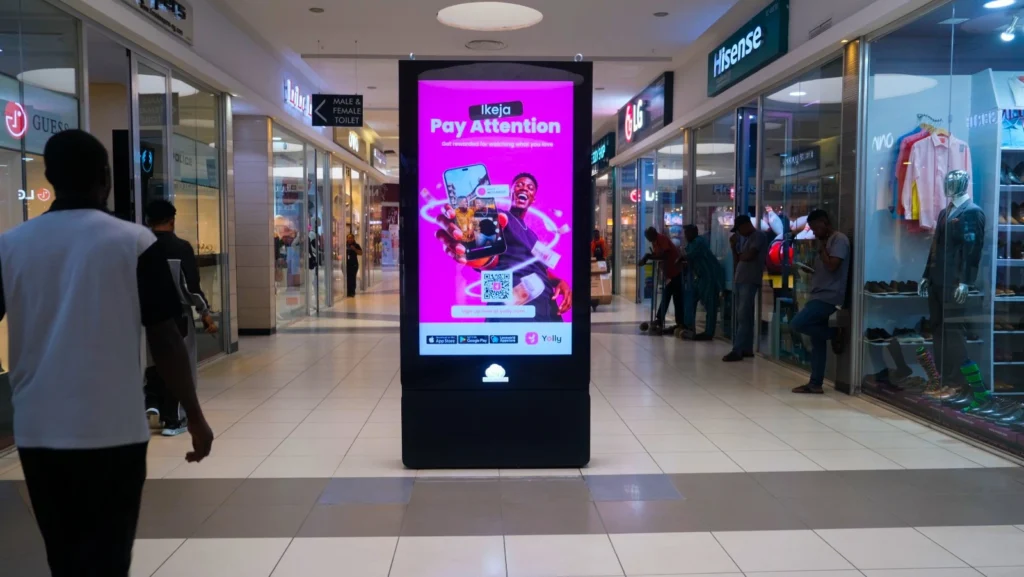
Nimbus’s work on Yolly’s “Pay Attention” campaign shows what the fuller version of this looks like. The core template stayed fixed across mall placements: the phone-in-hand visual, the rewards message, the QR code, the app download prompt. But two things changed with each location. The headline carried the specific neighbourhood, “Ikeja Pay Attention” at one mall, “Festac Pay Attention” at another, and, more importantly, the testimonial content changed with it: a different person, a different on-screen reward amount, deliberately chosen for each site rather than pulled from a single rotating pool.
That second layer is what separates this from a label change. The location name alone would have been the surface-level version the distinction above warns against. What makes it genuine adaptation is that the proof point next to it, who earned what, watching what, was tailored so the claim felt locally credible rather than generic. The proposition (get rewarded for watching what you love) never moved. The evidence for it did.
4. Creative and media planning need to meet earlier
The SportyTV rollout is a great example of strong, cohesive media planning and broad reach. As noted earlier, while that unified approach successfully locked down the core proposition across environments, it also provides a clear baseline for where future campaigns can evolve—pairing that robust media planning with format-specific creative variations.
What this means in practice
None of this argues for a different campaign at every location. The proposition should travel intact; that part of the SportyTV launch worked, and it’s exactly what held Yolly’s “Pay Attention” message together across malls too. The opportunity is in the execution: using a roadside site for what it’s good at, using a digital screen for what only it can do, and treating location as an input to the creative brief, the way Yolly’s testimonial content did, rather than a detail to fill in afterward.
A 2025 study of over 4,000 respondents across dozens of brands and advertisements found that the same creative can perform differently depending on the environment it appears in, reinforcing that context isn’t a neutral backdrop to advertising: it actively shapes how the message lands. For brands investing in OOH, the practical takeaway is straightforward. It’s not enough to ask how many locations a campaign can occupy. The more useful question is whether the creative at each of those locations is doing what that format and environment actually allow. Getting that right requires shifting timelines earlier in the campaign lifecycle, embedding it directly into the brief rather than waiting for the production phase.
CONTACT NIMBUS MEDIA
Written by
Lauretta Alaneme