
It’s 2 a.m. somewhere in Lagos, and a technician is threading cable through a service duct so a screen can go live exactly on schedule when the mall opens Monday morning. No one at the client’s office will ever see this. If everything goes to plan, no one is supposed to.
That’s the nature of execution in out-of-home advertising. When it’s done well, it disappears.
When it’s done badly, it’s the only thing anyone remembers about the campaign.
As Nigeria’s OOH industry enters its most competitive stretch yet, that invisible half of the job is becoming the thing that actually separates media owners from one another.
Nigeria’s OOH Market Is Growing Fast Growth Isn’t the Same as Performance Out-of-home has quietly become one of Nigeria’s strongest advertising stories. At a recent industry forum in Lagos, MediaTrack AdEx data presented by mediaReach OMD showed OOH investment growing at a 41% compound annual rate between 2021 and 2025 comfortably outpacing every other above-the-line channel, at a time when press and cable spend were shrinking.
Independent analysts value the market at somewhere around $150 million in 2025, with most forecasts pointing to it roughly doubling again by 2030 as digital screens spread further into malls, transit corridors, and urban centres. Regulation has matured alongside the growth: the Advertising Regulatory Council of Nigeria (ARCON) has tightened standards across the sector, and Lagos State’s moratorium on new roadside structures has made existing, well-run inventory more valuable rather than less.
None of that guarantees results for the brands paying for it. A fast-growing channel with inconsistent delivery just means more advertisers are exposed to the same risks. Which is exactly why execution has become the thing clients scrutinise hardest.
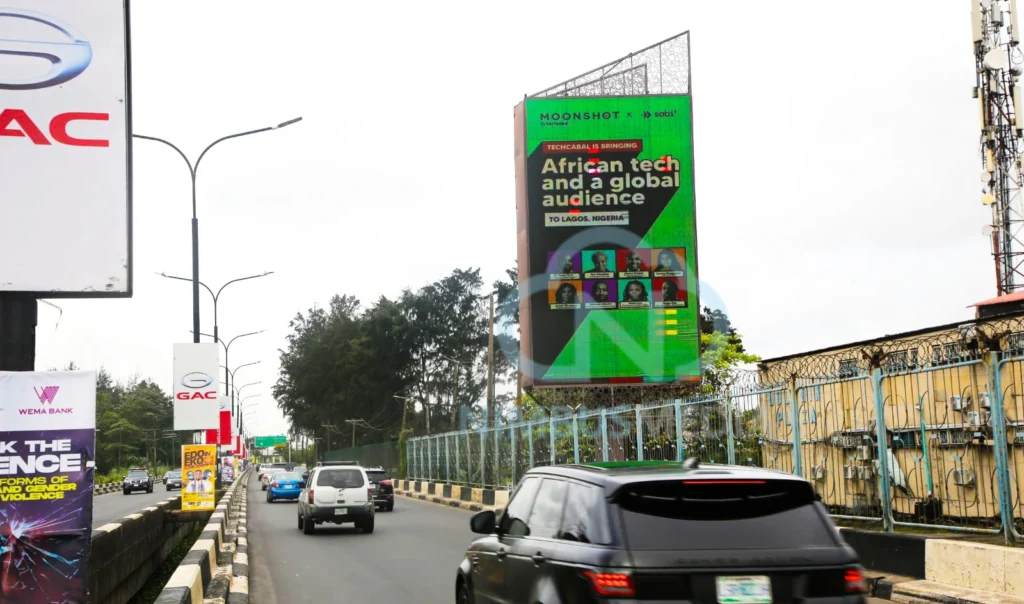
Buying the Space Is the Easy Part
Media buying answers one question where this campaign should appear. Execution answers every question that comes after whether the artwork went up on schedule, whether the screen is actually running, what happens the moment power fails, and how fast someone notices and fixes it.
None of that shows up in a media plan. All of it shows up in campaign performance.
A landmark billboard or a premium mall screen is only worth what it costs if the creative is live, current, and visible for the length of the flight. The location is the inventory. Consistent delivery is what turns that inventory into recall, footfall, and revenue and it’s just as easy to lose all of that value to a late installation or a week of downtime as it is to lose it to a bad location in the first place.
What It Actually Takes to Deliver a Campaign in Nigeria
Running OOH here comes with a specific set of operational realities that don’t show up in a lotof media plans: power interruptions, weather, logistics across cities with very differentinfrastructure, and the simple fact that Lagos, Abuja, Port Harcourt, and Kano don’t operatethe same way. The operators who handle this well tend to build around a few things: continuous, round-the-clock monitoring of screen and site uptime; contingency plans for power and weather disruptions before they happen, not after; rapid-response maintenance rather than reactive fixes; and increasingly, solar-powered infrastructure to reduce dependence on an unreliable grid. Investment in transit-linked inventory tied to Nigeria’s expanding rail lines is also starting to command premium rates, as advertisers chase the reach that comes with a captive commuter audience.
None of this is back-office detail. It’s the difference between a campaign that runs as promised and one that quietly underdelivers without anyone catching it until the report lands.
Why Advertisers Now Expect Proof, Not Promises
Digital OOH has changed what “trust me” means in this industry. Advertisers used to take delivery largely on faith. Now they expect playback reports, timestamped photo and video verification, real-time uptime data, and transparent communication for the length of the flight. The numbers back up why that shift matters. Nielsen’s research into digital out-of-home found that roughly two-thirds of viewers took some kind of measurable action after seeing a digital ad searching for the brand, visiting a store, engaging on social media. And OOH’s return on investment holds up against other channels: industry benchmarking from the Outdoor Advertising Association of America puts the average at $5.97 in sales for every $1 spent. Those figures come from mature markets rather than Nigeria specifically, but they explain exactly why advertisers here are asking harder questions than they used to. Estimated impressions aren’t enough anymore. Clients want proof the campaign actually happened the way it was sold.
Execution Is Becoming the Real Competitive Advantage
As the market matures, the gap between media owners is shifting. It used to be mostly about who had the best locations. Increasingly, it’s about who can deliver a campaign without surprises launching on time, staying live through the flight, catching problems before the client does and communicating clearly when something goes wrong.
Premium locations still matter. Pricing still matters. Creative still matters. But the operators who consistently execute without drama are the ones building the kind of trust that turns into repeat business.
How We Approach Execution at Nimbus Media
We think of execution as the actual job, not the part that happens after the job is sold. Every campaign we run goes through the same cycle: pre-deployment quality checks, professional installation, content scheduling, continuous monitoring, rapid maintenance response, and clear reporting back to the client throughout the flight not just at the end of it.
That discipline runs across our network, whether a campaign is live at Ikeja City Mall, Novare Mall Lekki, or Jabi Lake Mall in Abuja. It’s what lets a client focus on their marketing objectives instead of wondering whether their screen is actually on.
The Bottom Line
The future of OOH in Nigeria won’t belong to whoever owns the most inventory. It’ll belong towhoever advertisers trust to deliver consistently, and without needing to be asked twice.Great creative and strong locations get a campaign noticed. Execution is what makes sure it’s still running, still visible, and still working, for every day it was paid for.
What’s the difference between OOH media buying and OOH campaign execution?
Media buying secures the billboard, screen, or panel. Execution is everything after that installation, scheduling, monitoring, and maintenance which determines whether the advert is actually live and visible for the length of the flight.
Why does digital OOH need uptime monitoring?
Digital screens can go dark from power interruptions, technical faults, or scheduling errors.
Continuous monitoring means those issues get caught and fixed fast, so advertisers get the airtime they paid for.
How can advertisers verify their campaign is actually running?
Reputable OOH providers supply playback reports, timestamped photo or video evidence, and uptime data not just estimated impressions.
What operational challenges affect OOH delivery in Nigeria specifically?
Power interruptions, logistics constraints, weather, and infrastructure differences between cities like Lagos, Ibadan, Abuja, Asaba, Kano and Port Harcourt are the main factors that can disrupt installation and uptime if they aren’t managed proactively.
How fast is Nigeria’s OOH market growing?
Industry data presented at Lagos’s Top Trends 2026 forum put OOH investment growth at a 41% compound annual rate between 2021 and 2025 the fastest of any above-the-line channel in the country.
Why choose Nimbus Media?
We manage every stage of delivery pre-deployment checks, installation, scheduling, monitoring, maintenance, and reporting across premium advertising assets in high traffic locations including Ikeja City Mall, Novare Mall Lekki, Jabi Lake Mall Abuja, Novare Gateway Mall and Muritala Muhammad Airport.
Ready to run a campaign built on execution, not assumptions? Talk to the Nimbus Media team about premium digital out-of-home placements across Lagos and Abuja.
Written by
Ogunfowokan Damilola.