
Where Should Nigerian Brands Put Their Q4 2026 Budget?
As Nigerian marketing teams prepare for the final quarter of 2026, the familiar question returns: how much should go to traditional Out-of-Home advertising, how much to Digital Out-of-Home, and how much to online media?
The tempting answer is a percentage split. But there is no universal formula. A bank launching in a new state, an ecommerce company chasing transactions and an FMCG brand defending national awareness do not have the same communications problem. Their media budgets should not look the same either.
A better question is: what job should each channel do?
Traditional OOH is powerful at building public visibility and repeated reach. DOOH adds movement, scheduling and creative flexibility to that physical presence. Online advertising allows brands to target audiences, test messages and drive measurable actions. The strongest media plans do not force these channels to compete for one job; they use each where it is most effective.
First, separate DOOH from online advertising
The language can be confusing because DOOH is digital technology, but it is still Out-of-Home media. It is encountered in a physical location rather than inside an individual’s feed, browser or app.
Traditional OOH: Static billboards, street furniture, transit branding, wall drapes, building wraps and other fixed-format media placed in public space. The creative usually remains in place for a defined campaign period.
Digital Out-of-Home: Digital screens in roadside, retail, mall, airport, transit and other location-based environments. Creative can be scheduled, rotated and changed remotely; where the infrastructure allows, it can also respond to time, context or live data.
Online advertising: Paid media delivered through connected devices, including social media, search, websites, apps, online video and programmatic display. It can target and retarget individuals or audience segments and connect exposure directly to an online action.
That distinction matters. DOOH combines characteristics of physical and digital media, but it should not be evaluated as though it were simply a larger social-media screen.
Traditional OOH: reach, repetition and public presence
Traditional OOH remains valuable because it occupies real space along the routes and in the environments people use repeatedly. A well-chosen site can deliver sustained visibility to commuters, residents, shoppers and business audiences without requiring them to open an app, subscribe to a platform or click anything.
In Nigeria, where connectivity continues to improve but remains uneven in quality, affordability and geography, that broad accessibility matters. The Nigerian Communications Commission reported broadband penetration of 56.79% in June 2026. That is significant progress, but it is not a reason to assume that every relevant audience can be reached consistently and efficiently through online media alone.
OOH also makes a brand publicly visible. For launches, market entry, corporate reputation and high-consideration categories, a sustained physical presence can signal commitment and scale. Its limitation is flexibility: production and installation take time, messages cannot be changed instantly, and a poorly selected location can waste even excellent creative.
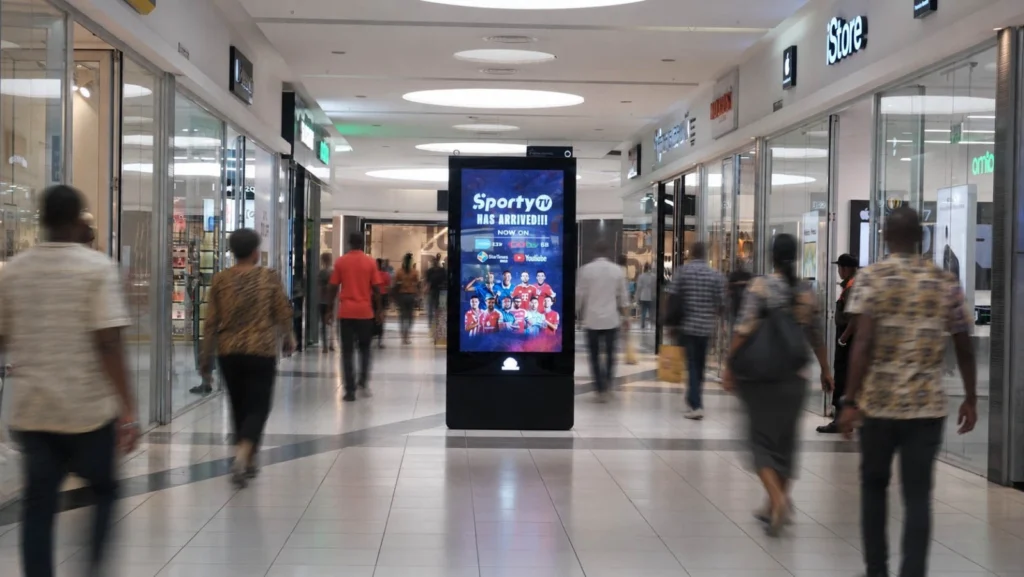
DOOH: physical reach with greater flexibility
DOOH retains the location value of OOH while giving advertisers more control over timing and creative. A restaurant can promote breakfast in the morning and dinner later in the day. A retailer can change an offer without printing and installing new material. Multiple creative executions can also tell a broader story across a campaign period.
This flexibility makes DOOH particularly useful for retail, entertainment, telecommunications, financial services and seasonal campaigns. Motion can attract attention, but movement alone does not guarantee effectiveness. The creative still needs to be legible within seconds, appropriate to the viewing distance and designed for the dwell time of the location.
Advertisers should also ask practical questions: How often will the message play? What share of the loop is being purchased? Is the screen operational and bright enough at the required time? What evidence of play and audience movement will be provided? A premium-looking screen is only valuable when the underlying delivery is reliable.
Online ads: targeting, testing and action
Online advertising is strongest when the objective involves a specific audience or measurable action. Search can capture existing intent. Social and online video can test messages quickly. Retargeting can reconnect with people who visited a website, watched a video or began a transaction. Campaigns can be adjusted while they are live, often with a lower entry cost than physical media.
Its advantages are real, and its share of advertising expenditure will continue to grow. PwC’s Africa Entertainment and Media Outlook expects digital formats to account for an increasing share of Nigerian advertising spend through 2029.
But precision should not be confused with certainty. Online campaigns operate in crowded feeds and depend on platform data, attribution rules and algorithms that advertisers do not control. Fraud, low-quality placements, short attention and naira exposure to foreign-currency platform pricing can weaken apparent efficiency. A low cost per click is not valuable if the clicks do not create customers or long-term brand demand.
The smartest budget gives each channel a job
Rather than beginning with a fixed percentage, brands should begin with the business outcome and build the mix backwards.
For a new brand or market entry: Use OOH and DOOH to establish visible presence and repeated reach, then use online media to explain the offer, capture interest and retarget exposed audiences.
For ecommerce, fintech or lead generation: Let online media carry more of the conversion work, supported by selective OOH or DOOH in locations that concentrate the intended audience and strengthen credibility.
For FMCG and mass-market campaigns: Use OOH for broad reach and frequency, DOOH for high-impact or time-sensitive creative, and online media for engagement, product education and audience feedback.
For retail, entertainment and events: Use DOOH near points of decision, supported by mobile and social activity that makes it easy to find, book, visit or buy.
For corporate reputation and trust: Use sustained physical visibility in strategically relevant locations, with online content providing evidence, explanation and a path to deeper engagement.
The exact allocation should be shaped by geography, audience behaviour, campaign duration, creative requirements, margin, available inventory and the outcome the business is prepared to measure.
Measure the channels differently – but judge them together
One reason media teams overinvest in online channels is that clicks and conversions are immediately visible, while the contribution of OOH may appear harder to isolate. The solution is not to ignore physical media; it is to improve measurement.
Traditional OOH can be assessed through verified site delivery, estimated reach and frequency, brand-lift research, changes in search activity, store traffic and geographic sales patterns. DOOH adds play logs, scheduling records, screen uptime and, where available, audience or footfall data. Online media can track reach, completed views, visits, leads, acquisitions and conversion costs.
These measures should be read together. If a physical campaign increases awareness, branded search and store visits while online media captures the resulting demand, crediting the final click alone gives an incomplete account of what created the customer.
Why Q4 requires an integrated plan
Q4 compresses some of Nigeria’s busiest commercial moments into a few weeks. Black Friday, Christmas, end-of-year travel, concerts, hospitality and the return of the diaspora increase consumer movement and intensify the competition for attention. Brands need to be visible, relevant and easy to act on at the same time.
The strongest approach is coordinated rather than fragmented. OOH can establish scale and familiarity before and throughout the season. DOOH can rotate offers, adapt messages to different moments and place creative closer to retail or entertainment environments. Online media can then capture interest, provide details, retarget audiences and make the next action immediate.
The plan should also be measurable from the beginning. Which locations are expected to influence the intended audience? Which message will run at which time? Should the response appear in searches, store visits, enquiries or sales? Were screens live when promised? Did the campaign generate business results, not merely impressions?
Prime inventory becomes more competitive as the festive season approaches. Brands that want coordinated OOH, DOOH and online activity should move early enough to secure the right locations, adapt creative for each format and agree on measurement before the campaign launches.
The verdict: do not choose a winner – design a system
OOH, DOOH and online advertising are not interchangeable, and none is automatically superior. The strongest Nigerian media strategy for Q4 2026 will connect their different strengths around one audience journey: be seen in the real world, remain relevant across locations and moments, and make the next action easy to take online or offline.
Nimbus Media helps brands and agencies plan, buy and execute OOH and DOOH campaigns across key Nigerian markets, while designing those placements to work intelligently within the wider media mix. The conversation should begin with the business objective – not with a format already chosen.
Ready to plan your Q4 mix? Talk to the Nimbus Media team about OOH and DOOH inventory across Lagos, Abuja and other key markets.
Sources and further reading
Nigerian Communications Commission, Industry Statistics – June 2026 broadband penetration data.
PwC, Africa Entertainment and Media Outlook 2025-2029 – Nigeria and regional advertising growth and digitisation outlook.
Mordor Intelligence, Nigeria OOH and DOOH Market – Third-party 2026 market-size estimate and growth forecast.
Out of Home Advertising Association of America – Industry research on OOH within broader acquisition and video strategies.
Written By
Moses Chinosa