
A Nimbus Media perspective on building real brand visibility through outdoor advertising in Nigeria
You’ll pass somewhere north of a hundred outdoor ads this week. Try naming three of them right now.
Most people stall after one.
That gap, between what crosses your eyes and what actually lodges in your memory, is the real contest in outdoor advertising, and almost nobody talks about it in those terms.
Over the past eight years, I’ve worked on both the agency and client side of the business. I’ve pitched campaigns to ambitious brands looking for “something big,” and I’ve sat in meetings defending every naira of media spend against business results. If there’s one lesson those experiences have taught me, it’s this:
Great outdoor advertising doesn’t shout the loudest. It becomes impossible to forget.
That happens when three elements work together: design, placement and repetition.
Get them right and you stop buying exposure. You start building memory.
1. Design: You Have Seconds, Not Minutes
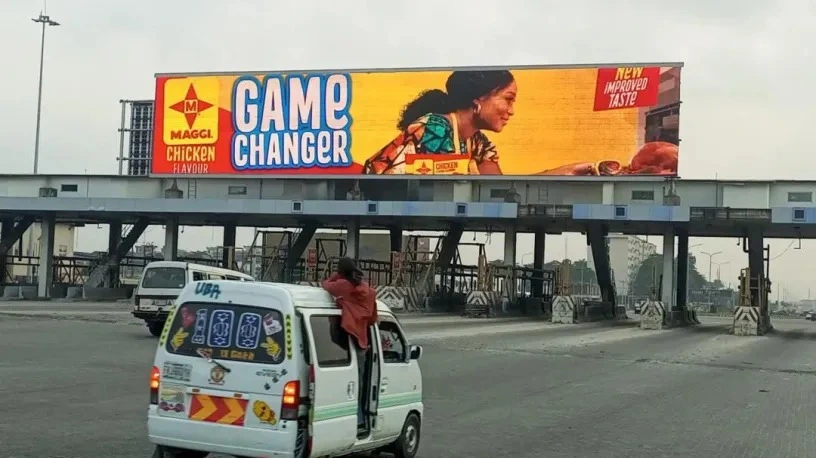
Outdoor advertising works through recognition, not reading.
The Out of Home Advertising Association of America estimates that the average roadside billboard gets only three to seven seconds of attention. That’s the industry’s three-second rule, and it remains one of the best creative disciplines available: if someone can’t identify your brand, understand your message and know what you want them to do after a quick glance, the design hasn’t done its job.
The same principle applies whether you’re using a traditional billboard, a digital screen or an LED display. A brighter screen doesn’t rescue a cluttered idea. It just makes the clutter easier to see.
Great billboard design is often less about what you include than what you’re willing to leave out.
Three principles consistently matter:
- One idea. Not five. If your billboard tries to communicate your price, product features, phone number, website, hashtag and brand story all at once, people will remember none of them.
- High contrast and bold typography. Thin fonts and subtle colour gradients may look beautiful on a designer’s monitor but often disappear under the realities of Lagos traffic and sunlight.
- Clear visual hierarchy. Your audience’s eye should move instinctively from the brand to the message and finally to the desired action.
One exercise I often recommend is the “windscreen test.” Look at the artwork for three seconds, then look away. If you can’t immediately recall the brand and the core message, the design probably needs simplifying.
2. Placement: Visibility Without Context Is Just Decoration
Imagine promoting luxury watches on a road where commuters have spent two hours worrying about fuel prices.
Now imagine showing the same campaign inside a premium shopping mall where people have already decided to spend.
Same creative. Completely different outcome.
Placement is about more than geography. It’s about mindset.
Someone walking through Ikeja City Mall or The Palms is in a very different frame of mind from someone navigating the Third Mainland Bridge during rush hour. One audience is browsing, comparing and making purchase decisions. The other is focused on getting home safely.
The creative should reflect that difference. A mall screen can carry a little more product information because the audience has time to engage. A roadside billboard cannot afford a single unnecessary word.
Nigeria’s outdoor advertising industry deserves close attention for this reason. The market continues to grow as premium locations expand and more traditional billboards move to digital formats. As outdoor media becomes more sophisticated and competitive, strategic placement only becomes more valuable.
The starting point for every media plan should be a simple question: where does our audience spend their time, and what frame of mind are they in when they get there?
A fintech product promoting quick access to credit may perform best along commuter routes where money is already top of mind. A skincare brand launching a premium product may do better in shopping centres where consumers are already thinking about purchases.
The location matters. The mindset matters more.
3. Repetition: Where Memory Is Built
Design gets you noticed. Repetition gets you remembered.
Psychologists call this the Mere Exposure Effect, first described by Robert Zajonc in 1968. The principle is simple: the more often people encounter something, the more familiar, and therefore more trustworthy, it begins to feel.
That’s why a carefully planned network of outdoor sites almost always outperforms a single spectacular location.
People don’t need to stop and study your billboard. They simply need to encounter it repeatedly, on the morning commute, during the school run, on the weekend drive to the mall, until your brand starts to feel familiar.
And familiarity matters. When customers eventually reach the point of purchase, they rarely evaluate every available option from scratch. More often, they choose the brand that already feels known.
The research backs this up. A joint study by the OAAA and Solomon Partners found that out-of-home advertising delivers the highest brand recall of any major media channel, at 86%, ahead of TV, radio, podcasts and online ads. Separate Nielsen research puts OOH recall at 47%, compared with 35% for digital media. Repeated exposure isn’t just a media planning principle. It’s a psychological one.
Repetition isn’t the boring part of an outdoor campaign. It’s where memory is built.
Stop Asking, “How Do We Make It Bigger?”
One lesson has become increasingly clear throughout my career: bigger is rarely the answer clients think it is.
Before approving a larger logo or a more expensive site, ask three better questions:
- Can someone understand this message in three seconds?
- Is it placed where our audience naturally spends time and attention?
- Will they encounter it often enough for it to become familiar?
Answer those questions well and you’re no longer simply buying advertising space. You’re building brand memory.
That’s the philosophy behind every campaign we develop at Nimbus Media. Whether we’re planning mall advertising, digital billboard networks or large-format outdoor campaigns, we’re designing for the glance, placing for the mindset, and planning for the repetition that turns a passer-by into a customer who remembers.
People rarely remember a billboard simply because it was big. They remember it because it appeared at the right moment, with the right message, often enough to become familiar.
That’s how an ad earns a second life in someone’s memory, long after they’ve driven past it.
Written by
Chinosa Moses