
Why the next decade of OOH belongs to the brands that can prove impact, not just buy visibility.
Part 3 of 3 in a Nimbus Media series on billboard ROI. Previously: Can a Billboard Really Increase Sales? | Why Most Nigerian Billboard Campaigns Fail
In this article
- Outdoor advertising is shifting from “trust us, people saw it” to measurable indicators search behaviour, footfall and sales correlation
- Nigeria’s OOH industry is already moving in this direction: a nationwide measurement study is underway in 2026
- Our approach at Nimbus business first, ecosystem thinking, proof over promises is the S.E.L.L. framework applied to every campaign we run
For decades, outdoor advertising was built around one simple promise: people will see your brand.
That was enough when media options were fewer and attention was easier to capture. Today, it is no longer enough.
Modern marketers are asking harder questions: Who saw the campaign? Did it influence behaviour? Did it improve brand perception? Did it contribute to business growth?
The future of outdoor advertising will not be defined by more billboards. It will be defined by better answers.
The industry is moving from a world where outdoor advertising was measured primarily by estimated impressions to one where brands increasingly expect evidence of commercial impact.
This does not mean outdoor advertising becomes identical to digital advertising. Its strength has always been different. Digital is powerful because it is targeted and interactive. Outdoor is powerful because it is public, unavoidable and capable of creating mass familiarity.
The opportunity is not to make outdoor behave like digital. The opportunity is to combine the strengths of both.
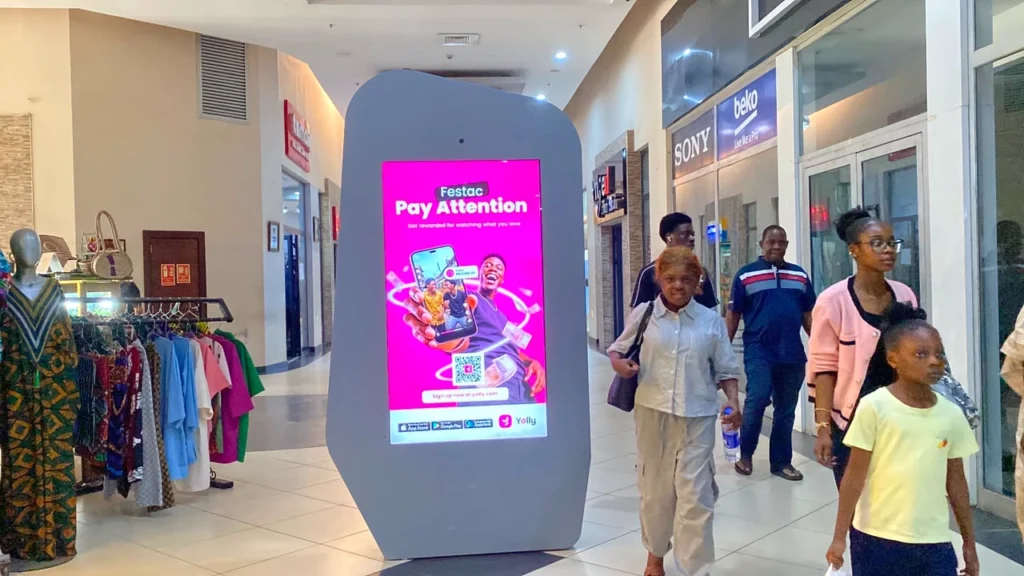
Measurement: Turning Visibility into Business Intelligence
One of the biggest criticisms of outdoor advertising has historically been measurement. A marketer could confidently report how many people clicked an online advert. But explaining the impact of a billboard campaign often relied on assumptions.
That is changing in Nigeria specifically, not just globally. A committee backed by the OOH Academy, including former Kantar and Dentsu Nigeria research leads, is currently running a nationwide audience behaviour study for the industry, with a report expected at the LOMA Conference in September 2026. The stated goal is the same one this article is making: give the sector a unified measurement system so brands can justify investment with data rather than estimates.
Search Behaviour
One of the simplest indicators of campaign impact is often what consumers do after exposure. When a brand launches a major outdoor campaign, increases in brand searches, website traffic, social media conversations and product enquiries can provide valuable signals that awareness is translating into interest.
This isn’t theoretical for Nigerian audiences. A 2020 OAAN/GeoPoll study found that 69% of Nigerians who saw an OOH ad went on to search for more information about it online close behind radio’s 74%, and ahead of most other measured channels.
The billboard may not generate the purchase directly. But it may create the curiosity that leads someone to search.
Footfall and Movement Patterns
Location matters because consumer movement matters. Understanding whether people exposed to a campaign later visit stores, restaurants, branches or retail locations provides a stronger picture of effectiveness.
The question evolves from “How many people passed this billboard?” to “Did exposure influence where people went next?”
Sales Correlation
Ultimately, businesses care about commercial outcomes. The strongest outdoor campaigns increasingly connect advertising activity with business performance.
For FMCG brands, this may involve comparing sales performance in areas where campaigns ran versus areas where they did not. For retail brands, it may involve analysing store performance before and after campaigns. For service businesses, it may involve tracking enquiries, applications or customer acquisition.
Outdoor advertising does not need to promise perfect attribution. Few marketing channels truly have that. But it does need to provide better evidence.
The future belongs to outdoor partners who can move the conversation from “Trust us, millions of people saw your billboard” to “Here is what changed because they saw it.”
Creative Is the Multiplier
A great location with average creative will produce average results. A great message in the wrong location will struggle. The most successful outdoor campaigns understand that location and creativity work together.
A billboard is not a newspaper page. It is not a website. It is not a presentation slide. It is a moment. The audience may have only a few seconds to engage with the message. That means simplicity is not a limitation it is a competitive advantage.
The strongest outdoor creative usually answers three questions:
Can people understand it instantly? If someone sees the billboard while moving, can they immediately understand what the brand is saying?
Can people remember it later? Recognition is the foundation of future buying behaviour.
Does it fit the environment? A message that understands its surroundings will always outperform a generic message. A billboard near a university campus should not communicate the same way as one beside a financial district. A campaign running during a major cultural moment should not ignore the conversation happening around it.
The environment is part of the message. The smartest brands do not simply place advertisements in locations. They create moments within locations.
The Election Cycle and Strategic Planning
Nigeria’s advertising market has always been influenced by major national events. The election cycle is one of them.
Historically, political advertising creates significant demand for outdoor inventory because campaigns rely heavily on visibility, reach and public presence. For commercial brands, this creates both an opportunity and a challenge: increased attention toward outdoor media, but increased competition for premium locations.
Smart marketers do not wait until the market becomes crowded. They plan ahead. Brands that understand their strategic objectives can secure valuable visibility before demand peaks and avoid competing purely on price and availability.
The lesson extends beyond elections. The best outdoor campaigns are rarely last-minute purchases. They are strategic investments planned around audience behaviour, business objectives and market conditions which matters more than ever in a Nigerian OOH market that industry estimates put at roughly $155 million in 2025, and growing at close to 15% a year.
The Objections, Answered
“Billboards Are Too Expensive”
The question should not be “How much does the billboard cost?” The question should be “What value is the billboard creating?”
Every marketing channel has a cost. The challenge is comparing value, not simply price. A cheaper channel that produces weak attention or low trust may ultimately be more expensive than a premium channel that strengthens the entire customer journey.
Outdoor advertising should be evaluated based on its contribution to business objectives, not only its media rate.
“We Cannot Track Outdoor Advertising”
Measurement is improving. But businesses must also recognise that not every marketing activity creates value in the same way.
A salesperson cannot always identify which billboard, radio mention or conversation convinced a customer to buy. That does not mean those activities had no impact.
Strong marketing combines available data with strategic understanding. The answer is not to abandon channels that influence customers. The answer is to measure them better.
“Our Customers Are Online”
They are. But they also commute. They shop. They attend events. They move through cities.
Consumers do not exist in digital spaces alone. The strongest brands understand that modern customers move between physical and digital worlds constantly.
The brands that win are those that understand the complete customer journey.
“Regulation Makes Outdoor Advertising Difficult”
Compliance is a reality of outdoor advertising in Nigeria. Responsible operators understand that regulations exist to protect the quality and sustainability of the industry.
The solution is not avoiding compliance. The solution is working with experienced partners who understand the environment and can ensure campaigns run effectively from planning to execution.
The Nimbus Perspective: Selling Outcomes, Not Space
The outdoor advertising industry is changing. And the conversation needs to change with it.
At Nimbus, we believe brands should never begin with the question “Which billboard can we buy?” The better question is “What business challenge are we trying to solve?”
Sometimes the answer is awareness. Sometimes it is distribution. Sometimes it is credibility. Sometimes it is defending market position. The billboard is simply the tool. The strategy comes
first.
Our approach is built around three principles the same S.E.L.L. framework from Part 2 of this series, applied end to end:
1. Business First
We start with the client’s commercial objective, not our available inventory.
If a brand’s challenge is retail penetration, the solution may not be the most famous billboard location. It may be a network of strategically selected locations close to purchase points. If the challenge is trust, premium visibility may matter more.
The right outdoor solution depends on the business problem.
2. Ecosystem Thinking
Outdoor advertising should strengthen everything else a brand is doing.
We believe OOH should connect with digital, radio, retail activation and sales efforts. The billboard should not operate alone. It should make every other marketing investment more effective.
3. Proof Over Promises
The future of outdoor advertising belongs to accountability.
Brands deserve more than photographs of installed campaigns. They deserve insight. They deserve learning. They deserve evidence that their investment is contributing to growth. That is the standard the industry must move toward.
Conclusion: Occupying Space Is Not Enough
So, can a billboard really increase sales?
Yes. But not because a customer sees a billboard and immediately decides to buy. That is not how most purchasing decisions work.
Outdoor advertising works because it creates familiarity. It builds credibility. It strengthens memory. It reduces uncertainty. It makes brands easier to choose when buying moments arrive.
The future of outdoor advertising is not about bigger boards. It is about smarter strategy. The brands that win over the next decade will not necessarily be the ones that spend the most on outdoor advertising. They will be the ones that understand how to use it as part of a broader growth strategy.
Because billboards have never simply been about occupying space. They have always been about occupying memory. And the brands that occupy memory are far more likely to occupy market share.
That is the future of outdoor advertising. Not more visibility. More value.
Contact us @nimbus.com.ng
Written by
Favour Emenike