
In a world of skippable ads and shrinking attention spans, the billboard has never been more important. Here is why.
If you have ever been stuck in traffic on the Third Mainland Bridge or inching along Ozumba Mbadiwe in Victoria Island, you already understand something powerful about advertising without necessarily realising it. The same billboard stares back at you every single day. The same logo. The same colours. The same message. And slowly, almost without meaning to, it becomes part of how you think about that brand.
That is not an accident. That is outdoor advertising doing exactly what it was designed to do. And it is doing it more effectively than most brands appreciate.
“Presence precedes preference. Before a consumer chooses a brand, they first have to remember it exists.”
A medium that refuses to be ignored
Every other form of advertising can be avoided. You scroll past social media ads. You skip YouTube pre-rolls. You change the radio station during commercial breaks. But a billboard on your daily commute? There is no skip button for that.
This is the fundamental power of Out-of-Home (OOH) advertising; it exists in the real world, occupying physical space in people’s lives. Unlike digital ads competing for a fraction of a second of attention on a crowded screen, a well-placed billboard commands presence simply by being there. Research from the Outdoor Advertising Association of Nigeria confirms what most commuters instinctively know: 79% of Nigerians noticed a billboard in the past seven days, and 63% said they noticed not just the visual, but the actual brand or message behind it. That is not passive exposure that is genuine communication reaching people in the flow of their daily lives.
One lesson we have consistently observed at Nimbus is when working with brands across Nigeria is that clients often underestimate the cumulative effect of outdoor presence. They measure a single campaign in isolation. But the brands that build the strongest recall are the ones that show up in the same locations, with consistent creative, over an extended period. Familiarity, in advertising as in life, builds trust.
How outdoor advertising builds brand memory
Brand memory is not built in a single moment. It is built through repetition, consistency, and sustained presence over time. Psychologists refer to this as the “mere exposure effect”, the more we are exposed to something, the more positively we tend to perceive it, even when we are not consciously paying attention. Out-of-Home advertising leverages this principle at scale and at a frequency that no other medium can replicate in the physical world.
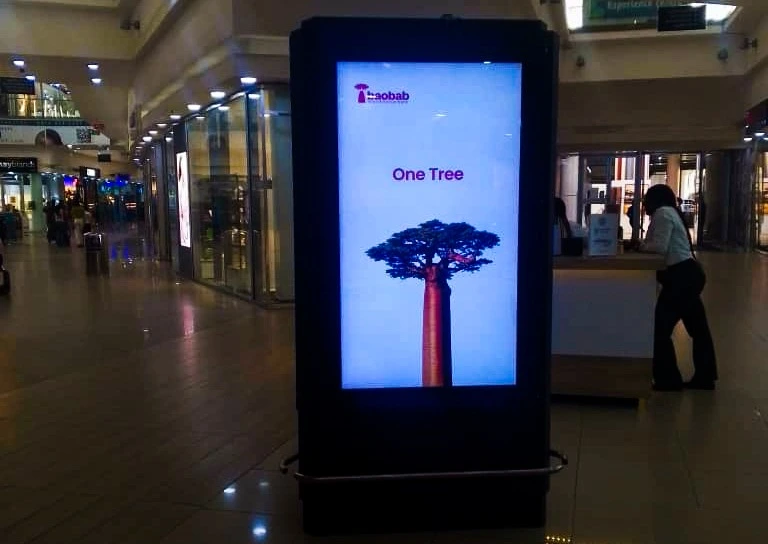
Digital Out-of-Home takes this further. Research shows that digital billboard formats generate 3.2 times more neurological response and memory activity than static formats which matters because it means the brain is not just seeing the ad, it is encoding it. On average, a digital Out-of-Home placement captures 12 seconds of focused attention, which neuroscientists consider sufficient for long-term memory formation. The practical implication for brands is significant: a consumer who sees a digital billboard on their commute is far more likely to recall that brand later in the day, at the point of purchase, than one who saw a banner ad they scrolled past in three seconds.
Across campaigns we at Nimbus have planned for clients in competitive Fast Moving
Consumer Goods and financial services categories, we have seen this play out directly. When brands maintain a consistent Out-of-Home presence in a market over a sustained period, their unaided awareness scores tend to rise not dramatically month to month, but steadily and durably. The challenge is helping clients see that billboard advertising is not a transaction; it is an investment in how a consumer’s mind gets organised.
The Nigerian context: why Out-of-Home hits different here
Nigeria is not just any market. It is Africa’s largest economy, with a young, mobile, urban population that spends significant time outdoors navigating some of the continent’s most congested cities. In Lagos alone, over 20 million residents travel daily through major corridors and that congestion, as frustrating as it is for commuters, creates something enormously valuable for advertisers: extended, repeated dwell time in front of well-placed boards.
Lagos accounts for approximately 65% of all national Out-of-Home spending, with Abuja contributing another 20%. Premium corridors like the Third Mainland Bridge, Ozumba Mbadiwe in Victoria Island, and the Lekki-Epe Expressway carry some of the highest daily impression volumes in West Africa. But impression volume alone does not tell the full story. What makes these locations powerful is the profile of the audience passing through them and the regularity with which they do so.
In our experience working with brands across Nigeria, location selection is where campaigns are won or lost before a single creative is produced. Two brands can run identical creative with identical budgets and achieve vastly different results based purely on site selection. The questions we ask clients are not just “where is the traffic?” but “where is your audience going, at what time, and in what frame of mind?” A financial services brand targeting corporate professionals requires a fundamentally different site strategy than a mass-market consumer goods brand.
From awareness to action: the bridge Out-of-Home builds
One of the most important and underappreciated findings in Out-of-Home research is the direct link between billboard exposure and consumer action. A joint study by the Out of Home Advertising Association of America (OAAA) and Google found that 46% of people who saw an outdoor ad searched for that brand online within 24 hours. This single finding reframes how brands should think about Out-of-Home entirely.
Outdoor advertising has historically been evaluated on reach and frequency, how many people saw the ad, and how often. But what this research reveals is that Out-of-Home does not just build awareness in isolation. It seeds intent. Someone sees a billboard for a bank on their morning commute. That evening, perhaps without consciously connecting the two events, they search for the bank online, visit the website, or mention it to a colleague. The billboard was not the last touchpoint before purchase but it was the touchpoint that made every subsequent one more likely to convert.
“Brands are remembered long before they are purchased. The billboard plants the seed.
Every other channel helps it grow.”
Nielsen ROI data supports this: billboard advertising generates an average of $5.97 in sales for every $1 spent. But the more important insight is not the multiplier it is the mechanism. Out-of-Home primes the consumer so that when they encounter a brand again at the shelf, on social media, or through a friend’s recommendation, the decision is already half-made. Familiarity has already done its work.
What consistent presence looks like in action is an example of How a challenger brand used sustained Out-of-Home presence to shift consumer perception A mid-sized consumer brand in a category dominated by two or three established players approached the question of brand-building with limited budget and an understandable instinct to concentrate on social media, where performance could be tracked in real time. Instead, we recommended a sustained Out-of-Home presence across a small number of high-frequency sites in their core market with fewer locations, maintained consistently over several months, rather than a wider spread across a shorter burst period. The result, measured through consumer recall surveys conducted before and after the campaign period, showed a meaningful improvement in unaided brand awareness among commuters in the target corridors. More telling was what consumers said when asked how they had come to know the brand: many named the billboard locations specifically, describing them as if the brand had “always been there.” That sense of established presence for a brand that had been advertising for less than a year is what sustained outdoor visibility actually creates. Not just awareness. Authority.
Creative that earns its space
Not all billboards are equal. The medium is powerful, but execution determines whether that power is harnessed or wasted. In Nigeria specifically, where competition for attention on major corridors is intense, creative quality is not a secondary consideration; it is the difference between a board that registers and one that disappears into the visual noise of the road.
The brands that consistently perform well in Out-of-Home share a few non-negotiable habits. Their messaging is clear enough to absorb in three seconds at speed. Their visual identity is consistent with the same colours, fonts, and brand cues across every touchpoint, so that recognition compounds over time. And critically, they treat
Out-of-Home as part of a wider campaign story rather than a standalone placement. When outdoor advertising echoes what a consumer hears on radio or sees on television that evening, the effect is multiplicative, not additive.
From our perspective one of the most common mistakes we see is brands producing outdoor creative that was clearly designed for a different medium: a television ad or a social media post compressed onto a billboard. Effective Out-of-Home creative is built for the format from the ground up. It respects the constraints: limited reading time, variable viewing distance, changing light conditions. The brands we see succeed are the ones that treat the billboard not as a canvas for everything they want to say, but as a single, powerful statement of what they stand for.
The global picture: Out-of-Home is growing, not fading
Some predicted that digital advertising would make outdoor irrelevant. The opposite has happened. The global Out-of-Home market surpassed $40 billion in annual revenue in
2025 and continues to grow not despite the rise of digital media, but partly because of it. Consumers exhausted by tracking, targeting, and the relentless personalisation of online advertising have responded more warmly to a medium that is simply present, honest, and impossible to avoid.
In Nigeria, this trajectory mirrors the global trend. Ad spending in the country’s
Out-of-Home market continues to grow as urbanisation increases, digital screens proliferate in major corridors, and brands increasingly recognise that physical presence carries a credibility that digital formats struggle to replicate. A brand visible on the Third Mainland Bridge sends a different signal than a brand visible on Instagram and in certain categories, particularly financial services, telecoms, and premium consumer goods, that signal matters enormously.
What this means for brands in Nigeria
For any brand serious about building lasting presence in Nigeria, Out-of-Home is not optional, it is foundational. The research is consistent, the consumer behaviour data is clear, and the practical experience of practitioners who plan and execute these campaigns day after day points in the same direction: brands that show up consistently, in the right places, with clear and culturally resonant creativity, build memory and trust faster than those that do not.
The mistake brands make is treating outdoor advertising as a cost rather than an investment, something to cut when budgets tighten rather than a strategic asset that compounds in value over time. The brands that own a consumer’s mental landscape are not the ones that spend the most. They are the ones that have been present the longest, most consistently, in the places that matter most to their audience.
Presence precedes preference. In advertising, the brands that get remembered are not always the loudest, they are the most consistently there.
Written by
Oluwatokemi Fagade