
Why Smart OOH Advertising Location Strategy Wins Every Time
Most brands still think about Out-of-Home advertising the wrong way.
They focus on visibility before relevance.
They ask:
“Where can we get a billboard?”
Instead of asking:
“Where does our audience actually live, move, wait, spend, and make decisions?”
That distinction is everything.
Because in OOH advertising, location is not just a detail in the media plan. Location is the strategy.
You can have a brilliant campaign, world-class creative, and a strong product. But if your message appears in the wrong environment, in front of the wrong audience, at the wrong moment, the campaign underperforms no matter how beautiful it looks in a presentation.
The brands that win in OOH are not always the brands with the biggest budgets.
Often, they are simply the brands with the smartest placement strategy.
Start With Human Behaviour, Not the Billboard
Too many campaigns are planned around available inventory instead of audience behaviour.
But consumers do not move randomly through cities.
Lagos alone has its own rhythm.
The executive commuting through Ozumba Mbadiwe every morning behaves differently from the university student moving through Yaba, the trader navigating Oshodi, or the family spending the weekend at Ikeja City Mall.
Strong OOH planning starts by understanding those patterns.
A fintech brand targeting upwardly mobile young professionals may perform better along key commuter corridors, business districts, co-working environments, and premium retail locations than on a random high-traffic expressway.
A fast-food brand, on the other hand, needs proximity to movement, impulse, and convenience — near schools, transit hubs, fuel stations, markets, and busy intersections where people are already thinking about their next meal.
A luxury brand may gain more value from controlled premium environments than from mass exposure.
This is why audience intelligence matters.
Visibility without relevance is just expensive decoration.
Why Footfall Beats Fame
One of the biggest mistakes brands make is confusing famous locations with effective locations.
A site can be iconic and still perform poorly for your objective.
The real question is not:
“Is this location popular?”
The real question is:
“Does the audience here match the customer we are trying to influence?”
High-footfall environments such as malls, supermarkets, transit interchanges, major junctions, and commuter routes create repeated exposure throughout the day. But exposure alone is not enough.
Context matters.
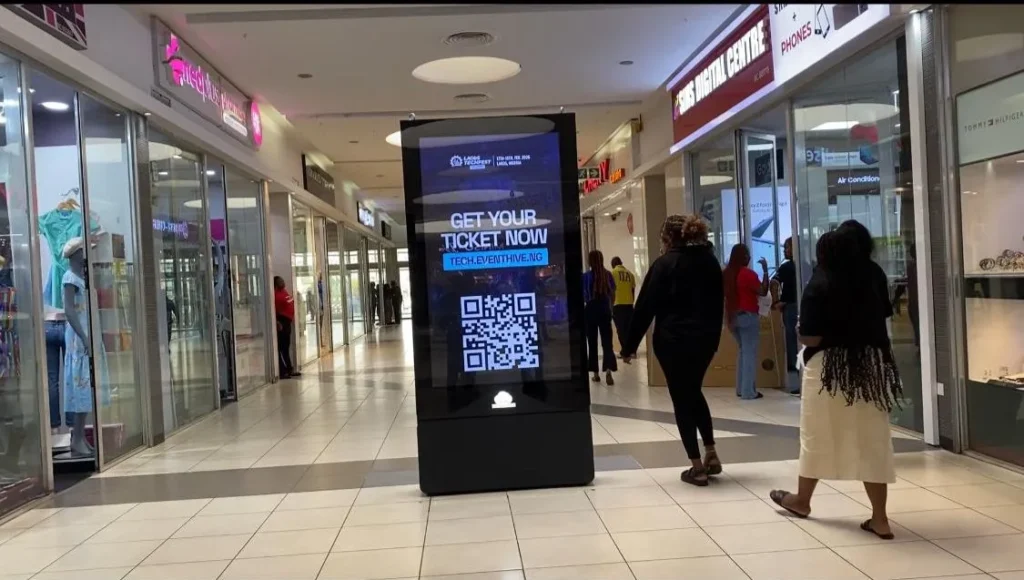
A digital screen inside a premium retail environment like Jabi Lake Mall in Abuja or Ikeja City Mall in Lagos places your brand directly in front of consumers already in a buying mindset.
That proximity to commercial intent can be more valuable than a larger site with weaker audience alignment.
The best OOH locations do not simply generate traffic.
They generate relevant attention.
What Makes a High-Performance OOH Site?
The strongest-performing OOH sites typically combine several factors:
- High daily vehicular or pedestrian traffic
- Strong alignment between audience profile and brand target
- Sufficient dwell time for message absorption
- Clear visibility and minimal environmental clutter
- Proximity to retail, service, or purchase environments
- Consistent audience movement patterns throughout the day
A billboard people pass is not the same as a billboard people notice.
And a billboard people notice is not always the same as one that drives action.
The difference is strategy.
Think in Journeys, Not Individual Sites
The most effective OOH campaigns rarely depend on one location.
They work because they follow consumer movement.
A prospect sees your brand on Third Mainland Bridge during the morning commute.
Later in the day, they encounter your message again near their office district.
That evening, they see your digital placement inside a shopping mall or retail environment.
By the third or fourth touchpoint, your brand is no longer unfamiliar.
It becomes recognised.
And familiarity builds trust.
This is one of the most powerful advantages of OOH advertising when deployed correctly.
Out of Home Advertising Association of America (OAAA) research consistently shows that OOH significantly improves ad recall and purchase intent, particularly when integrated into broader media strategies. https://www.oaaa.org/research/
The strongest campaigns are not random collections of sites.
They are intentional systems of repeated audience interaction.
Location Is Also a Brand Signal
In OOH advertising, the environment surrounding your message affects how the message itself is perceived.
Before people even process the creative, they subconsciously process the location.
A premium placement inside an upscale mall communicates aspiration and quality.
A dominant presence near a major transport corridor communicates scale and market confidence.
A placement directly outside a retail location communicates convenience and immediacy.
This is why OOH planning is not simply a media exercise.
It is also a brand-building decision.
The location becomes part of the story your brand is telling.
The Future of OOH Is Data-Driven
The era of gut-driven site selection is ending.
Today, the smartest brands are using audience intelligence and movement data to make more precise placement decisions.
Modern OOH planning increasingly draws from:
- Traffic count and vehicular flow analysis
- Footfall measurement in retail environments
- Audience movement patterns and demographic insights
- Proximity analysis linked to category behaviour
- Contextual behavioural mapping around purchase intent
This allows brands to reduce wastage and improve campaign efficiency.
The conversation is gradually shifting from:
“How many billboards did we buy?”
to:
“Did we place the brand in the right environment to influence behaviour?”
That is a much more intelligent conversation.
How Nimbus Approaches OOH Strategy
At Nimbus Media, we believe OOH planning should be rooted in audience behaviour, movement patterns, and business objectives — not simply inventory availability.
Our approach combines strategic placement thinking with strong local market understanding.
Across Lagos, Abuja, Owerri, and other key Nigerian cities, we work across digital screens, static billboards, lamp post advertising, transit environments, and retail OOH platforms.
But more importantly, we focus on helping brands understand where attention, movement, and commercial intent intersect.
Because the best OOH campaigns do not just occupy space.
They influence behaviour.
And in a market as dynamic and fast-moving as Nigeria, understanding how people move through cities is becoming one of the most valuable competitive advantages a brand can have.
The Bottom Line
A great campaign in the wrong location is a missed opportunity.
But the right campaign, placed in the right environment, in front of the right audience, with the right frequency, can shape perception, build trust, and drive measurable business results.
The future of OOH will not belong to the brands with the most billboards.
It will belong to the brands that understand movement, context, attention, and audience behaviour better than everyone else.
That is where smart OOH strategy wins.
To explore Nimbus Media’s OOH platforms and strategic advertising solutions across Nigeria, visit https://nimbus.com.ng
You can also follow Nimbus Media on:
- LinkedIn – https://www.linkedin.com/company/nimbus-media-limited
- Instagram – https://www.instagram.com/nimbusmediang?igsh=Mzc1cmE0dWEwZW1p
Written By
Favour Emenike